Sorry dear English Readers, I didn't spend time to translate by myself
[Field Report] My Logbook with AI Agents – Episode 1: What Did I Actually Gain?
A dated log of how I've used AI agents across 5 areas: only one saved me time. Rebound effect, work intensification: I didn't save time, I invested it.
Key takeaways
- Training courses and blog: AI helps me with substance, not with the clock. Research, writing, formatting: I don't save time, but I put my effort where it matters, on the substance.
- Software development: easy on simple projects, painful on complex ones. My website came together quickly and well; my app got bogged down, trampling along the way on my own advice as a coach.
- Rebound effect and work intensification: research predicts it, I'm living it. When producing gets cheaper, we produce more, in parallel, and on our own free time.
For a long time, I kept my distance from AI, and was even irritated by how systematically it was being used, given what I saw as the low value it created compared to its (overall) cost.
Since the start of 2026, I have to admit that usage has grown, and above all the use cases have started to speak to me a lot more. So I began experimenting more concretely, mainly to support certain tasks, especially meeting notes.
Then I got swept up in the agentic AI hype... Experience reports, videos showcasing use cases, advertising? They got the better of my fragile convictions.
And above all, I had a personal click: for years, my creative mind has been generating ideas and projects that my lazy streak and/or my fear of confronting those ideas with reality stop shortly after the initial thinking, leaving me with the frustration of not fully realising myself. I told myself the time had probably come to get going: experimenting, building projects I'd never started, digging deeper into a few leads...
Well, spoiler alert: I ended up doing what I used to reject... photo montages to illustrate my talks...
So this article is mostly a personal diary, to record how I feel right now and to question what I need to learn going forward. The section "What the research says" puts my field report in the context of the current state of research on the impact of AI.
The scale
Like the "feels like" temperature in a weather forecast, I relied on a subjective measure of time and value. Both axes are scored from -5 to +5, so I have:
- perceived time saved: 0, no gain; negative, time lost; positive, time saved;
- perceived value produced: same logic, did it create value (from my point of view)?
In the next section, you'll find a gauge illustrating the perceived impact on time and value. It's also consistent with the METR survey available online¹, which splits speed and value in the same way.
The logbook
The freshest context: training courses
At the start of the year, I began using AI more to produce the content of my training courses. Back then, it was with Copilot, to generate some of the slides. It wasn't very industrialised, rather tedious to do, although fairly effective in the end.
Version 2 came in September: I stepped up a level and truly industrialised production thanks to agentic AI. On my side, I focused on the thinking, my objectives, the structure and substance of the content, the key points the course absolutely had to get across, and left the AI to check that what I was saying was consistent, add references and, above all, produce all the materials needed for the two days.
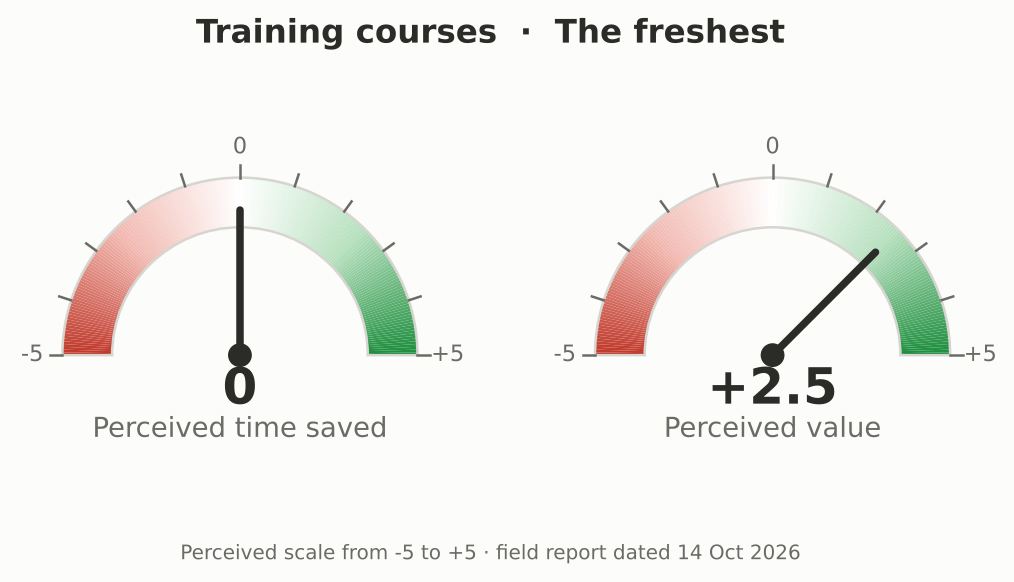
My takeaway on time: zero impact.
- at first, I felt I was spending an enormous amount of time on this course;
- when I analysed the metrics of the conversation, I realised I had indeed spent a lot of time on it, but no more than I would have without AI.
This freedom on form let me focus on the substance of my preparation, which was a real advantage for me and, apparently, for the participants (the feedback I've received so far rates the course 5/5). I put the gain in perceived value at +2.5.
My conclusion: the effort shifted from form to substance. No time saved, but more productive time.
The most positive context: the myrtille.coach website
This is where I feel I've had the best result so far: setting up my website, even though there were no real business stakes in it. I could have used existing SaaS solutions, but spending time and frustration on the result didn't appeal to me; I preferred to keep control of the build. The consequence was that I had to find the time to do it myself. I kept putting this experiment off, telling myself I didn't have the time.
In the end, I used Junie in IntelliJ, without much method: mostly a conversation with the agent so that it would build a number of features. The result is clean and fast, and I didn't have to deal with everything I'm not good at: design, UX, CSS.
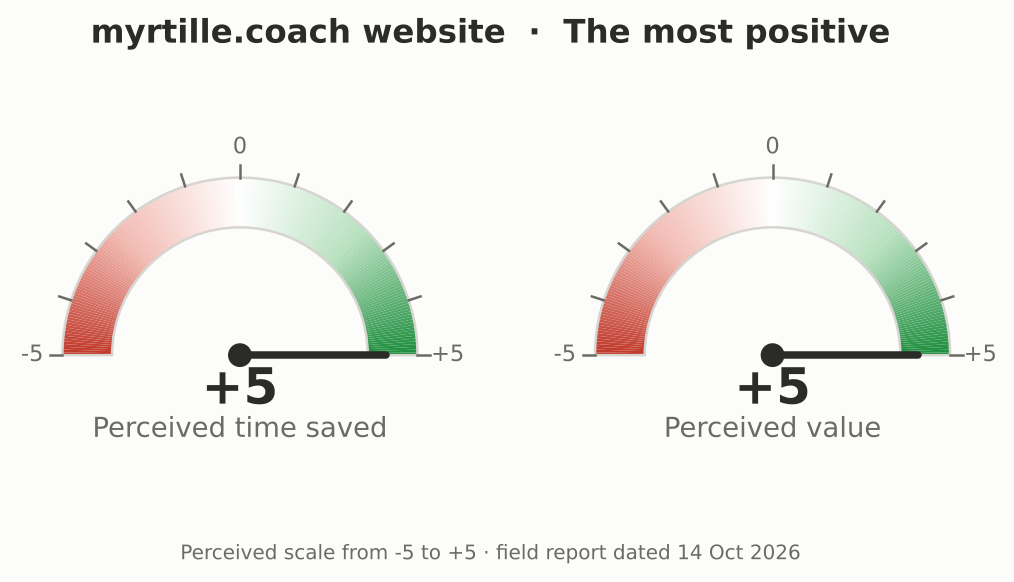
On my scale, I give it +5 across the board, value and time: the time saved is admittedly time I wouldn't have invested anyway, but the time I did spend was genuinely productive and satisfying, all the more so since I was delegating what I'm less good at.
The never-ending context: blog posts
Another case similar to how I felt about the training: blog posts. I followed broadly the same path, with a version 1 based on Copilot, not industrialised, and on top of that not true to my personality.
And now, a more industrialised version: I keep control over the pool of topics, which come from my own ideas, over the angle and over the argument. I leave it to the AI to look for documented sources; it helps me structure, correct and validate. I remain in charge of the writing and the tone.
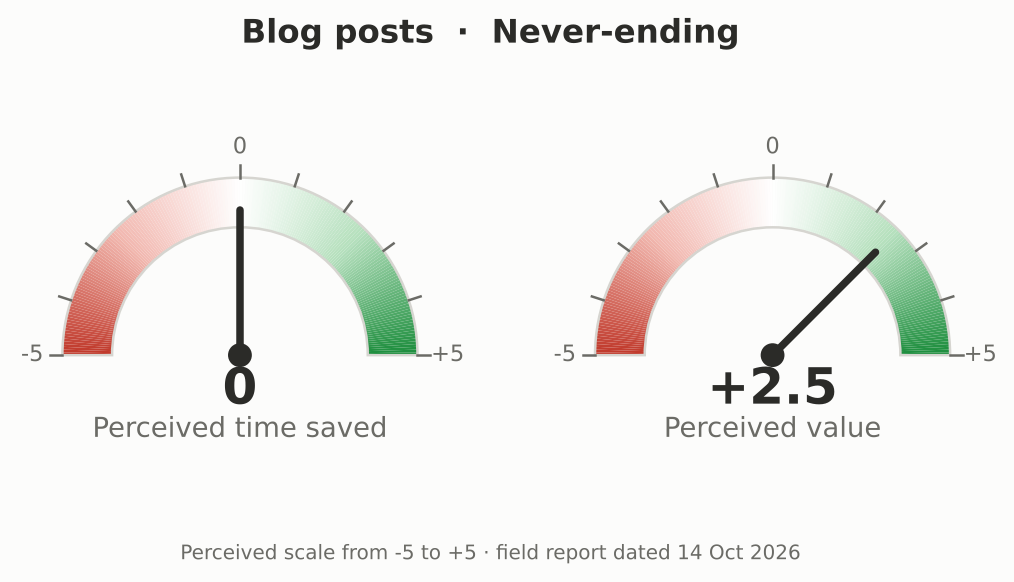
Same conclusion as for the training: it lets me focus on substance, with no real time saved, but with much more productive time, which ultimately helps me build my value and my positioning.
If I only give it 2.5 for perceived value, it's because for now I get more visibility from short, spontaneous posts (see the latest one about Skull King) than from these more polished articles.
The most painful context: the wealth-management app
The subject that, for now, leaves me with a real sense of unfinished business (and indeed, this project remains unfinished) is this wealth-management app.
I really wanted to experiment with a product and development approach based on BMAD, to understand how my peers use it, and also to produce value on an app that interested me.
Where I stand for now:
- I spent an enormous amount of time on it over the summer;
- the AI also spent an enormous amount of time on it (compute time, my subscription's capacity);
- I'm very happy with the discovery and framing phase;
- on the other hand, I got completely lost in the delivery part, and the result is nowhere near what I expected.
My starting assumption: I would spend less time, get results faster and produce an MVP to test.
What actually happened is that I apparently got the calibration badly wrong: we went way too far, for way too long. The shoemaker's children go barefoot, and apparently so does the agile coach...
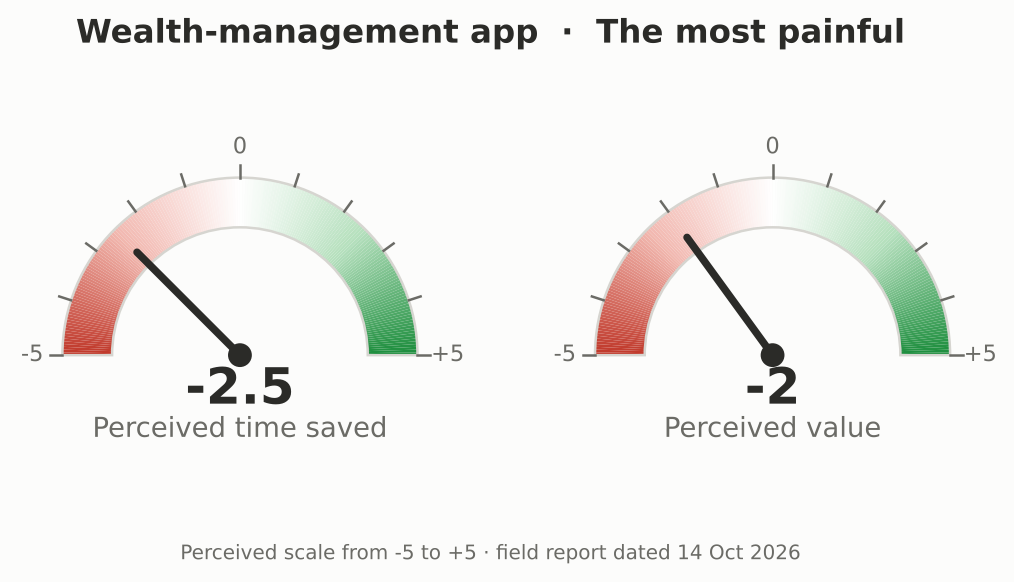
So I score perceived time at -2.5 and value at -2, because I genuinely feel I wasted my time, and that I currently have a project that doesn't destroy value, but brings nothing and doesn't satisfy me at all.
I'm going to pick this project up again in the coming days, to try to move it forward, review what doesn't work for me and what I can improve. So I hope its impact on time and value will move in the right direction.
The most personal context: my running training
The last experiment, a more personal one: running. For many years now, I've chosen not to commit to a club or a coach for this activity. It's mine, and I'm happy with the way I experiment and make my own mistakes.
This autumn, I have goals for the 13 km du Rhône race:
- at the very least, beat my personal best;
- an ambitious goal: go under one hour;
- a dream goal: with a time under the hour... "then maybe...", as a famous sports commentator yelled himself hoarse during a legendary women's 4x400 m relay.
Right now, I rely on AI to validate my preparation approach, for training suggestions and for structure. The funny part is that the AI is much harder on me than I would be on myself. My lazy streak probably shows up in how I set my goals, too.
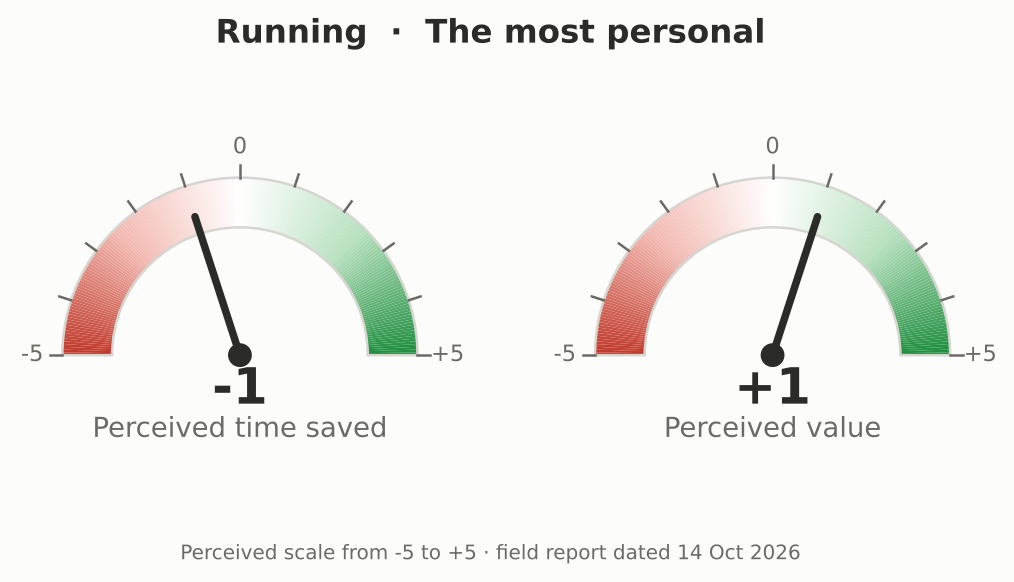
On my scale, I give it -1 for time, because it's extra time I'm spending, but +1 for value, because for now it helps me structure things better and think more about what I'm doing. For the final result, and therefore the conclusion, we'll have to wait until the end of November.
Summary of my experiments
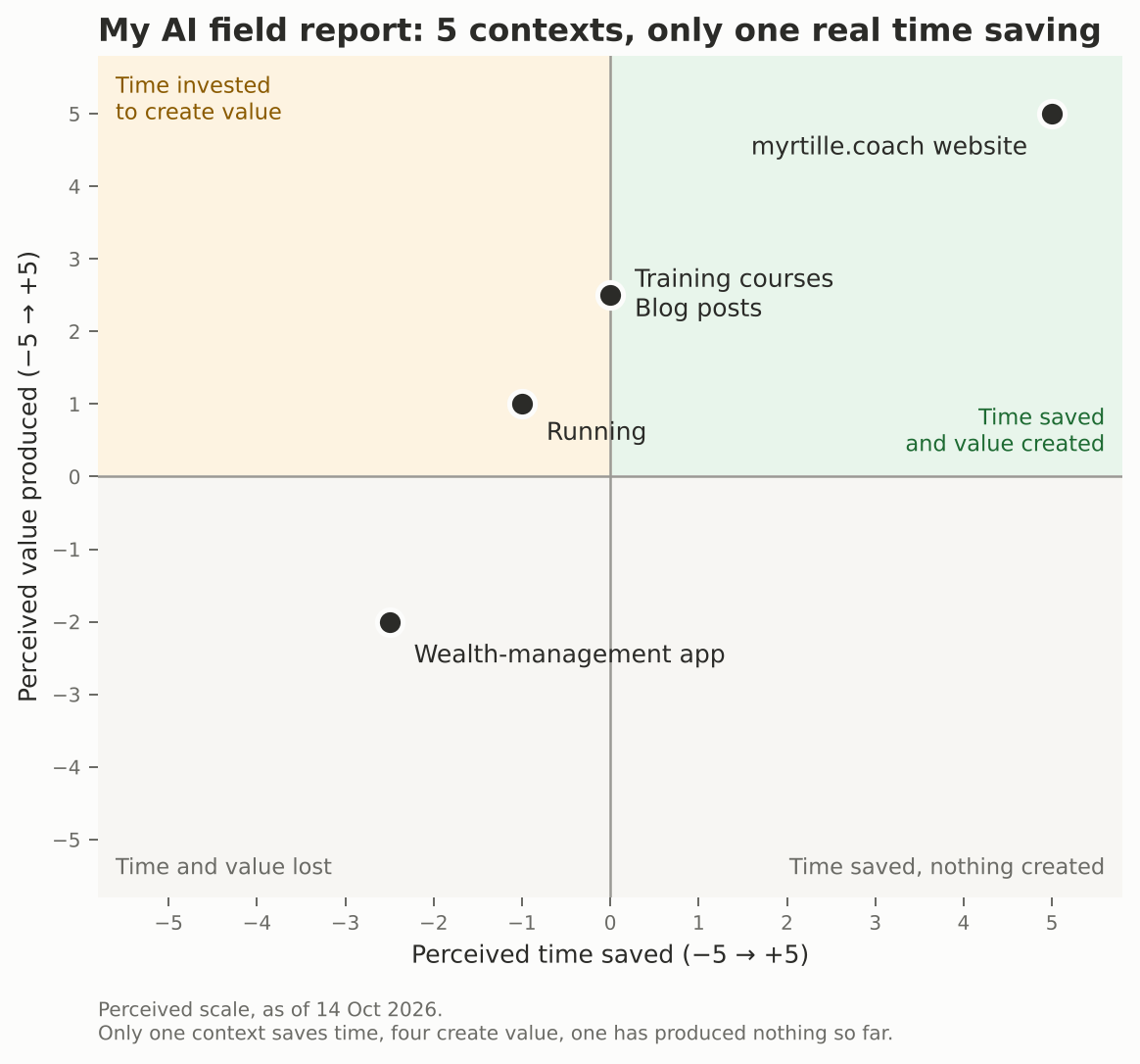
What the chart shows: out of five contexts, only one saves time, and it's the lowest-risk one. Four bring value, sometimes only a little. Only one has produced nothing so far: the wealth-management app, the only one where I expected to save time. Elsewhere, in my areas of expertise, no time saved, but the effort shifts towards substance.
What the research says
Even if my goal is to keep a logbook, it's still worth comparing how I feel with what the research currently says.
We misjudge what we gain
METR's 2025 to 2026 studies show:
- large perceived gains¹, while the measurements show a slowdown (2025)² or are inconclusive (2026)³;
- 30 to 50% of the developers surveyed said they had left some tasks out of the study because they didn't want to do them without AI³.
When AI becomes the default, we no longer really know what to compare against.
This matches my own experience, which, on top of that, went both ways (hoping to save time on the wealth-management app and feeling I'd lost it / feeling I was losing time on the training course when that apparently wasn't the case).
AI doesn't reduce work, it intensifies it
This is a point I expressed implicitly while writing up my experiences, and one that really struck me during the research phase.
For 8 months, Ranganathan and Ye observed a tech company⁴˒⁵: employees revived long-postponed tasks, worked in parallel, sent prompts over lunch and in the evening, without anyone asking them to. In the moment, momentum; looking back, a feeling of being busier and less able to switch off.
Intensification means multitasking and fragmented attention: the researchers describe several threads run in parallel and attention constantly jumping from one to the other⁴.
It reminds me of a workshop I took part in several years ago: the "agile first-name game"⁶, a multitasking exercise run by Alfred Almendra.
Why? The rebound effect
The Jevons paradox describes the fact that when a resource becomes cheaper, we consume more of it.
I had already experienced this effect with access to knowledge, made easy and unlimited by my phone: whenever I had a doubt, even mid-conversation with friends, out came the phone to check.
Hamilton Mann even talks about a "cognitive rebound effect": what was occasionally useful ends up used all the time⁷.
Access to extra working capacity through AI leads me to launch lots of projects, and amplifies the intensification described above.
I didn't save time, I invested it
So the right question wasn't "how much time do I save?" but "how much time do I invest, and for what return?"
As we saw in the previous section, the rebound effect shows that value becomes cheaper to produce, so we produce more of it, and we spend more time on it, including our free time.
I had already received a warning from Karl Furgerot's field-report talk⁸, in which he flagged how much of his free time he spent chatting with AI, and how hard it was to balance personal life and this project.
On my side, I already have the phone reflex I described above. So I need to give myself a warning: my current use of AI risks increasing my multitasking, fragmenting my attention and intensifying my usage.
If this happens to me, voluntarily, on my own free time, what happens in teams who are promised time savings thanks to AI? That promised time saving can turn into intensification.
It therefore becomes essential to have a manager or a coach who protects a sustainable pace⁹ and supports the choice of what value to produce. The Berkeley researchers' recommendation points the same way: build an "AI practice"⁵, a set of shared norms and rules on how to use AI. The idea: don't let everyone intensify themselves in their own corner.
See you at the next field report
I'm giving myself an appointment for the next field report, with two open questions:
- how can I measure, factually, time saved or lost, and value? (This will probably deserve an article of its own.)
- how do I find the balance between the ease of the tool and personal life?
I plan to repeat this exercise by December, hopefully with a less subjective measure.
Notes
¹ METR, "Measuring the Self-Reported Impact of Early-2026 AI on Technical Worker Productivity", metr.org, May 11, 2026. Self-reported survey of 349 technical workers.
² METR, "Measuring the Impact of Early-2025 AI on Experienced Open-Source Developer Productivity", metr.org, July 10, 2025. Randomized controlled trial with 16 experienced developers.
³ METR, "We are Changing our Developer Productivity Experiment Design", metr.org, February 24, 2026.
⁴ Aruna Ranganathan and Xingqi Maggie Ye, "AI Doesn't Reduce Work—It Intensifies It", Harvard Business Review, February 2026.
⁵ Berkeley Haas Newsroom, "AI promised to free up workers' time. UC Berkeley Haas researchers found the opposite", February 18, 2026 (updated April 28, 2026).
⁶ "Le prénom agile" (in French), coach-agile.com, June 3, 2019.
⁷ Hamilton Mann, "AI Productivity's Blind Spot", California Management Review, January 26, 2026. The author applies the Jevons paradox to knowledge work and talks about a "cognitive rebound effect".
⁸ Karl Furgerot (Younup), "IA & vibe coding : comment livrer un produit sans savoir coder ?" ("AI & vibe coding: how to ship a product without knowing how to code?"), talk at TALK IT Tour Lyon – Spécial IA, Lyon, June 11, 2026 (in French).
⁹ Principles behind the Agile Manifesto, 8th principle: "Agile processes promote sustainable development."