Sorry dear English Readers, I didn't spend time to translate by myself
AI, Scrum, Cargo Cult: Are We Making the Same Mistake Again?
Why are companies making the same mistakes with AI as they did with Scrum? Analysis of cargo cult, survivor bias, and the real conditions for success.
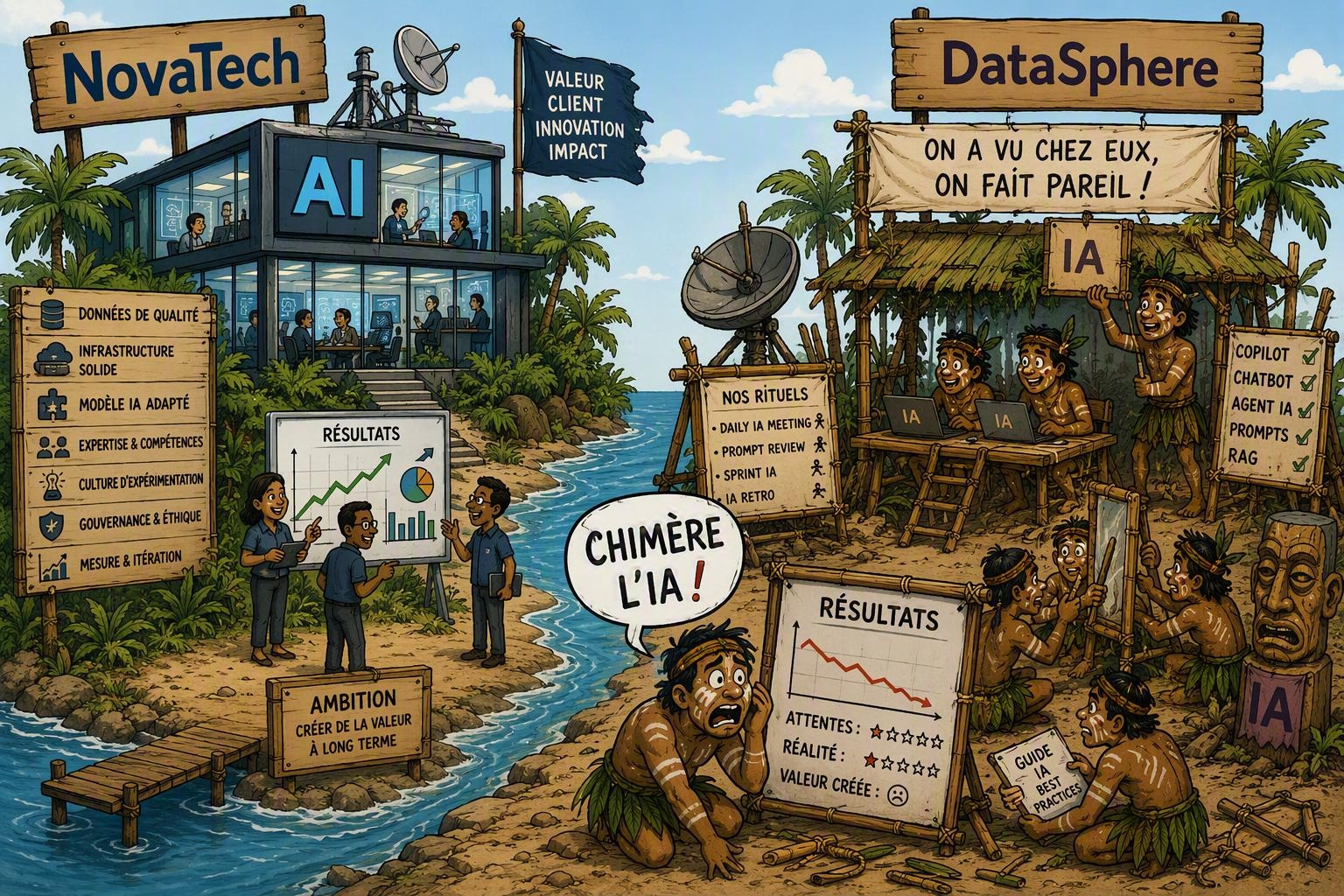
During World War II, some inhabitants of Pacific islands saw soldiers arrive who were able to speak into devices and then receive food, equipment, and medicine from the sky. They then began to reproduce what they saw, attributing in their cultural framework the abundance and sophistication of goods brought by cargo to divine favor (Wikipedia article).
Myth, anthropological simplification, or historical reality—it ultimately doesn't matter.
What has stood the test of time is the idea of the cargo cult: reproducing what is visible without questioning the underlying principles or reasons for the practice, hoping to achieve the same result.
Build a landing strip. Mimic a control tower. Build a wooden radio.
The reasoning seems absurd today.
Yet, have we really stopped?
In the software world, we have already experienced the "Scrum Cult".
Companies reproduced Daily Meetings, Sprint Reviews, or Scrum roles by observing high-performing organizations without taking into account everything that was below the surface: culture, leadership, team autonomy, product quality, experimentation capacity, customer relationships.
Today, I sometimes feel like we are doing it again with AI.
Others are doing it, so let's do it too
The logic is understandable. No one wants to miss a revolution.
When a company announces spectacular gains thanks to AI, the natural reaction is: "If they can do it, why can't we?"
The problem is that we mostly observe the visible elements. Licenses. Copilots. AI assistants and agents. Impressive demonstrations.
But the plane doesn't arrive because of the landing strip.
Behind the success stories, there is often an invisible infrastructure:
- Years of digital transformation;
- A culture of experimentation;
- Actionable data;
- Modern technical architecture;
- Adapted governance;
- Teams capable of questioning their habits…
AI sometimes looks like this "magical" technology that seems to produce value instantly.
Yet, like any technology, its potential depends heavily on the environment in which it is used.
Another common pitfall: generalizing results obtained in very specific contexts.
A demonstration performed by two experts on a new project is not necessarily reproducible on a critical, legacy system, distributed among several teams, with strong regulatory constraints.
It is therefore important to contextualize the results and reproduce experiments in other contexts to evaluate possible gains under those conditions, identify parameters to change, find the right solution, or pivot.
Moreover, AI is not free.
And it will probably cost more and more as usage increases. Not to mention that the providers of these solutions will expect a return on investment (what will be the price of tokens in a few months / years).
As always, the question should not be, in my view:
"How to produce more thanks to AI?" or "How to produce cheaper thanks to AI?"
But rather:
"How to produce what creates the most value for our users, customers, and company thanks to AI?"
The goal should not be to seek the completeness of expressed expectations without looking at the cost. The magic of AI must not make us forget to evaluate the return on investment of our achievements. Just because we can do everything doesn't mean we should do everything.
The real challenge often remains the same Pareto principle: identifying the 20% of efforts that generate 80% of the value. After that, do we continue on the remaining 80% of efforts or do we find another value axis?
Yet, there are already winners
Conversely, ignoring AI would probably be just as dangerous an error.
Some companies have clearly taken a significant lead.
It would be just as dangerous to ignore weak signals. Companies like GitHub / Microsoft Copilot, Klarna, or Duolingo demonstrate that real gains already exist:
- acceleration of certain tasks;
- reduction of delays;
- creation of new products;
- improvement of customer experience;
- opening of new markets.
But none obtained these results by simply installing a tool. Behind every success are years of technological investment, organizational transformation, and experimentation.
Economic history is full of companies that didn't disappear because they ignored a technology, but because they underestimated the model change it brought. Kodak knew about digital and even invented it in 1975. Blockbuster knew about the Internet. Nokia knew about smartphones. The problem was not the absence of information.
The problem was believing that the world would continue to function as before without taking into account an underlying trend. The fear of "missing the boat" is therefore not irrational.
AI has also become an attractiveness factor. Yesterday, some companies displayed agility everywhere to recruit. Today, many highlight AI.
Sometimes as a marketing argument. Sometimes because they have truly engaged in the transformation. And talents look at this with attention.
The problem is not the technology, but the intention
In reality, we observe the same pattern at every revolution.
We quickly copy visible practices. But the benefit doesn't come only from AI but from its integration into a favorable environment (Example of GitHub / Microsoft Copilot).
Then, we quickly demand financial results or immediate production gains.
At every revolution, we reproduce the same reflex. We adopt a new technology and then immediately ask it for financial results. The Internet was supposed to generate profit by the end of the 1990s. The Cloud was supposed to lower costs from the first year. Agility was supposed to instantly increase productivity. Today, AI must reduce headcounts while increasing production. Yet, the most successful transformations have rarely started with a cost reduction goal. They started with a clear ambition, and then economic results arrived as a consequence of that ambition.
Klarna first highlighted impressive gains ($40M savings in recruitment) achieved through AI and automation of customer interactions, then hired humans again in the face of a surge in customer complaints (reference). The choice of indicators for the transition to more AI should have included a quality measure, and then the transition could probably have been done more slowly: prioritizing medium/long-term gain over immediate profit.
The greatest successes were rarely born from a single goal of immediate profitability.
- The iPhone was not designed to optimize a financial ratio. The ambition was to reinvent the smartphone experience.
- AWS was not born as a strategic plan intended to become a major business. Originally, Amazon was first looking to solve its own infrastructure problems. Financial results came later.
They were the consequence of ambition. Not the ambition itself.
With AI, we must also avoid another trap: survivor bias.
We see the companies that tell of their success (cf. the example of Klarna above).
We see the conferences and case studies published after a few months of practice.
We see and believe the storytelling.
But we rarely see:
- abandoned experiments;
- investments not recouped;
- stopped projects;
- promises that never materialized.
As in many current topics, sensational information is widely shared and commented on for a period; its update, if more ordinary, is often crushed by another sensational piece of information.
Conclusion
The risk is not experimenting with AI.
The risk is believing in the chimera of immediate gain. We fall back into the cargo cult in this last expectation, by the way.
Replacing part of salary costs with a technology without having evaluated its real cost, its organizational impact, and its return on investment can lead to the same disillusions as all previous revolutions.
We have the right to be wrong; we even have an interest in experimenting: thanks to the speed of AI implementation, we will even be able to realize it more quickly with a well-implemented Lean and Product approach.
But before asking for results, let's set a course:
- A clear ambition.
- A direction.
- A purpose for the transformation.
Because a successful transition does not consist of copying a neighboring company's landing strip.
It consists of understanding why planes land there.
And you, what course do you want to give to AI in your organization: reduce costs, increase created value, or reinvent your way of working?